
Ниво на урока: А1-А2
Време за изпълнение – 120 мин.
Разяснение
Броят на времената в английския език е 14. Съпоставен с броя в българския език, те са едва 9. Предпоставка, която сама по себе си води до объркване.
Чрез класификация на вемената според различни критерии целя да внеса яснота в представата ви за тях, организирайки ги в логична рамка.
Запознайте се с индивидуалното обучение по бизнес английски език.
Запознайте се с индивидуалното подготовка за интервю за работа на английски език.
Прости и сложни времена
Първата класификация е представянето им в две категории, а именно: прости и сложни времена.
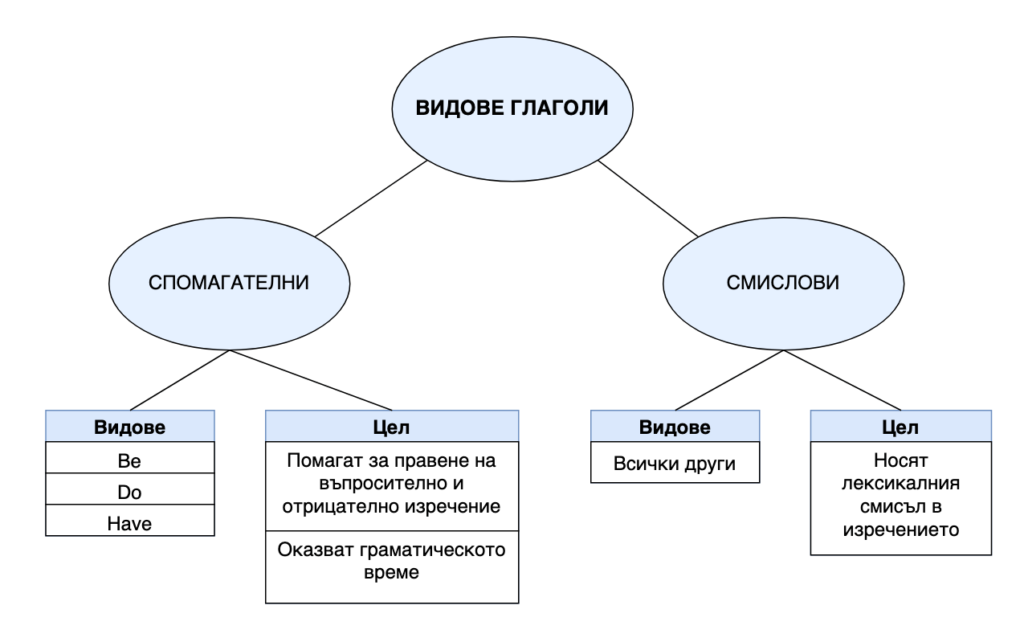
Критерият тук е начинът, по който се изразява действието. В простите времена действието е изразено с един глагол, който е смислов /V1/. В сложните времена действието е изразено с два и повече глагола, където единият е смислов, а останалите спомагателни Vo.
Смисълът от подобна класификация на времената е елиминиране грешките при структуриране на въпросително и отрицателно изречение. Виж граматически урок „Структура на изречението в английския език“. Както вече знаем, всяко въпросително изречение /Yes-No-Questions/ започва със спомагателен глагол, а всяко отрицателно изречение съдържа отново спомагателен глагол на второ място, който спомагателен глагол „носи“ отрицанието – частицата “not”.
Простите времена са само две: Сегашно просто и Минало просто /Present Simple and Past Simple/. Те образуват въпросително и отрицателно изречение с помощта на спомагателния глагол Do, който съответно за минало време е Did /когато в изречението отсъства глаголът Be в ролята си на смислов глагол/.
Предвид своя характер: прости времена, в разказно изречение действието се изразява само с един глагол – смислов. Поради отсъствието на спомагателен глагол, смисловият глагол е „натоварен“ с функцията да „носи“ граматиката. Т.е. не само да придаде смисъл за естеството на самото действие, но и да окаже граматически характеристики /лице, граматическо време – минало или сегашно/. В трето лице ед.ч. в сегашно просто време глаголът получава окончание S, а в минало просто време ползваме втората форма на глагола, ако същия е неправилен или добавяме ed при правилните глаголи. Виж граматически урок „Видове глаголи“.
Поради отсъствието на спомагателен глагол в разказно изречение в простите времена, принципът на инверсия /разместване на глагола с подлога/ за образуване на въпросително изречение тук е неприложим.
Следователно: за да попитаме следва да внесем „отвън“ спомагателен глагол. Глаголът, който „помага“ на простите времена е Do.
ПРИМЕРИ
| Positive (of ‘play’) |
|---|
| I play |
| you play |
| he plays |
| she plays |
| it plays |
| we play |
| they play |
- Don't forget the 's'! Even really advanced students do this!
- For a few verbs, there is a spelling change before the 's'. For example, 'study' becomes 'studies
- Few verb that are irregular in the present simple:
- 'have' becomes 'has'
- 'do' becomes 'does'
- 'go' becomes 'goes'
To make the negative form, you need to use 'do not' (don't) or ' does not' (doesn't).
| Negative (of ‘play’) | Negative Short Form |
|---|---|
| I do not play | I don't play |
| you do not play | you don't play |
| he does not play | he doesn't play |
| she does not play | she doesn't play |
| it does not play | it doesn't play |
| we do not play | we don't play |
| they do not play | they don't play |
Question form of the present simple tense
We use 'do' or 'does' before the subject to make the 'yes / no' question:
| Yes / No Questions |
|---|
| do I play ? |
| do you play ? |
| does he play ? |
| does she play ? |
| does it play ? |
| do we play ? |
| do they play ? |
Just like with 'be', if you'd like to make a 'wh' question, you just put the question word at the front:
| Wh Questions | Wh Questions |
|---|---|
| where | do I play ? |
| what | do you play ? |
| why | does he play ? |
| who | does she play ? |
| when | do we play ? |
| how | do they play ? |
Простите времена от своя страна се делят на прости времена на смислови глаголи и прости времена на глагола Be.Когато в изречението присъства глаголът Be в неговите сегашни или минали форми /am, is, are, was, were/отпада нуждата да търсим помощ от спомагателния глагол Do. Това е така, защото глаголът Be сам по себе си е и спомагателен и като такъв има „силата“ да застава пред подлога във въпросително изречение /характеристика, присъща само на спомагателните глаголи/. Следователно тук можем да приложим правилото на инверсията /разместване/.
ПРИМЕРИ
Here's the positive form (positive means a normal sentence, not a negative or a question. This is sometimes called 'affirmative')
| Positive | Positive Short Form |
|---|---|
| I am | I'm |
| you are | you're |
| he is | he's |
| she is | she's |
| it is | it's |
| we are | we're |
| they are | they're |
Next, here's the negative. It's very easy. You only add 'not'.
| Negative | Negative Short Form |
|---|---|
| I am not | I'm not |
| you are not | you aren't |
| he is not | he isn't |
| she is not | she isn't |
| it is not | it isn't |
| we are not | we aren't |
| they are not | they aren't |
And finally let's talk about the question form of the present simple with 'be'.
Firstly, here's the 'yes / no' question form:
| Yes / No Questions |
|---|
| am I ? |
| are you ? |
| is he ? |
| is she ? |
| is it ? |
| are we ? |
| are they ? |
If you'd like to make a 'wh' question, you just put the question word at the front:
| Wh Questions | Wh Questions |
|---|---|
| where | am I ? |
| what | are you ? |
| why | is he ? |
| who | is she ? |
| when | are we ? |
| how | are they ? |
Сложни времена
Сложните времена според този критерии на класификация на времената са всички други. При тях съответно действието или състоянието е изразено с два или повече глагола, от които единият задължително е смислов, а останалите спомагателни. Наличието на спомагателен глагол в разказно изречение прави приложима правилото за инверсия.
ПРИМЕРИ
Present Continuous
Here is how we make the positive:
| Positive | Positive Short Form |
|---|---|
| I am sleeping | I'm sleeping |
| you are sleeping | you're sleeping |
| he is sleeping | he's sleeping |
| she is sleeping | she's sleeping |
| it is sleeping | it's sleeping |
| we are sleeping | we're sleeping |
| they are sleeping | they're sleeping |
We can make the negative by adding 'not':
| Negative | Negative Short Form |
|---|---|
| I am not sleeping | I'm not sleeping |
| you are not playing | you aren't playing |
| he is not reading | he isn't reading |
| she is not working | she isn't working |
| it is not raining | it isn't raining |
| we are not cooking | we aren't cooking |
| they are not listening | they aren't listening |
Questions are also really, here we also put 'am', 'is', or 'are' before the subject to make a 'yes / no' question:
| Yes / No Questions |
|---|
| am I eating chocolate ? |
| are you studying now ? |
| is he working ? |
| is she doing her homework ? |
| is it raining ? |
| are we meeting at six ? |
| are they coming ? |
For 'wh' questions, just put the question word at the front:
| Wh Questions |
|---|
| Why am I eating chocolate ? |
| What are you studying now ? |
| When is he working ? |
| What is she doing ? |
| Why is it raining ? |
| Who are we meeting ? |
| How are they travelling ? |
Future Simple
Here's the positive form (it's just 'will' + infinitive):
| Positive | Positive Short Form |
|---|---|
| I will meet him later (I'll ..) | I'll meet him later |
| You will come (you'll..) | You'll come |
| It will rain tomorrow (it'll) | It'll rain tomorrow |
| She will be late (she'll..) | She'll be late |
| He will help us later (he'll..) | He'll help us later |
| We will get married in September (we'll) | We'll get married in September |
| They will cook dinner (they'll..) | They'll cook dinner |
The short form: 'll is almost always used when speaking. It's really much more natural to say 'I'll' instead of 'I will'.
Next, here's the negative form (just add 'not' - remember will not = won't):
| Negative |
|---|
| I will not go (I won't ..) |
| You will not be late (you won't ..) |
| It will not snow tomorrow (it won't..) |
| She will not get the job (she won't..) |
| He will not pass the exam (he won't ..) |
| We will not come (we won't..) |
| They will not stop (they won't ..) |
Finally, here's the question:
| Yes / No Questions |
|---|
| Will I go? |
| Will you come early? |
| Will it be cold? |
| Will she dance? |
| Will he arrive soon? |
| Will we cook? |
| Will they leave? |
| Wh Questions |
|---|
| Where will I go? |
| Why will you come early? |
| When will it be cold? |
| Who will she dance with? |
| What time will he arrive? |
| What will we cook? |
| When will they leave? |
Present Perfect
To make the positive present perfect tense, use:
- 'have' / 'has' + the past participle
- Make the past participle by adding 'ed' to regular verbs (for example, 'play' becomes 'played')
- There are a few verbs that change their spelling when you add 'ed' (for example, 'study' becomes 'studied')
- We also have some completely irregular verbs
| Positive | Positive Short Form |
|---|---|
| I have played | I've played |
| you have worked | you've worked |
| he has written | he's written |
| she has walked | she's walked |
| it has rained | it's rained |
| we have travelled | we've travelled |
| they have studied | they've studied |
The negative is really simple too. Just put 'not' after 'have' or 'has':
| Negative | Negative Short Form |
|---|---|
| I have not eaten breakfast today | I haven't eaten |
| you have not been to Asia | you haven't been |
| he has not seen the new film | he hasn't seen |
| she has not played tennis | she hasn't played |
| it has not snowed this winter | it hasn't snowed |
| we have not slept all night | we haven't slept |
| they have not tried the food | they haven't tried |
To make a question, put 'have' or 'has' in front of the subject:
| 'Yes / No' Questions |
|---|
| have I missed the bus? |
| have you visited London? |
| has he worked as a waiter before? |
| has she met John? |
| has it been cold this week? |
| have we arrived too early? |
| have they studied English grammar before? |
As you can imagine, for 'wh' questions, we just put the question word before 'have' or 'has':
| 'Wh' Questions |
|---|
| where have I left my umbrella? |
| what have you done today? |
| why has he gone already? |
| where has she been in the UK? |
| why has it rained so much this summer? |
| what have we done? |
| where have they learned English before? |
Разбирането на подобна класификация на времената в английския език, а именно разделяйки ги на две категории: прости и сложни, според критерия – наличие или отсъствие на спомагателен глагол в разказно изречение, води до напълно елиминиране на грешките, допускани в структуриране на въпросително и отрицателно изречение. Виж Граматически урок: „Структура на английското изречение“
Упражнения с отговори
https://www.perfect-english-grammar.com/present-simple-exercise-7.html
https://www.perfect-english-grammar.com/present-simple-exercise-8.html
https://www.perfect-english-grammar.com/present-simple-exercise-16.html
https://www.perfect-english-grammar.com/present-simple-exercise-9.html
https://www.perfect-english-grammar.com/simple-present-exercises.html
https://www.perfect-english-grammar.com/present-continuous-exercise-5.html
https://www.perfect-english-grammar.com/simple-future-exercise-3.html
https://www.perfect-english-grammar.com/present-perfect-exercise-4.html
Приложение
| S V ... . | Разказно |
| Vo S ... ? | Въпросително |
| S Vo not ... . | Отрицателно |
Запознайте се с индивидуалното обучение по бизнес английски език.
Запознайте се с индивидуалното подготовка за интервю за работа на английски език.


